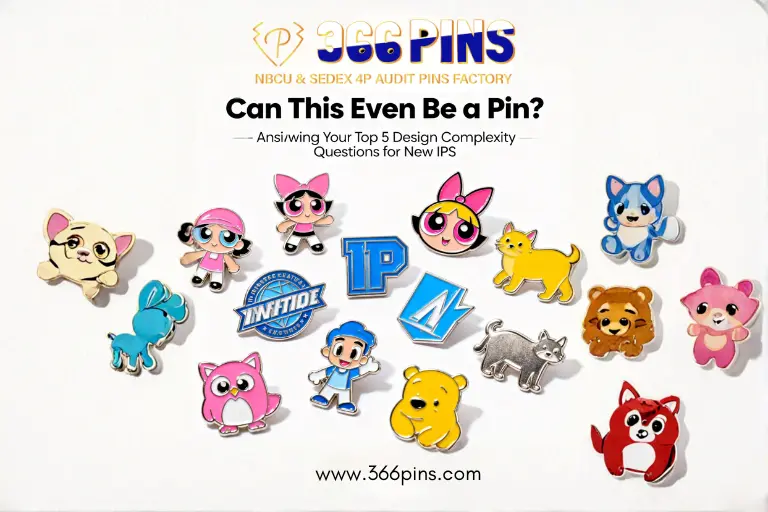
If you’re a brand or IP holder new to the world of enamel pins, you’ve likely stared at your beautifully intricate character artwork and wondered: “Can this even be made into a pin?”
It’s our most common—and most important—starting question at 366pins. That detailed linework, that gradient sunset, those tiny expressive eyes… they feel inseparable from your character’s identity. The fear that manufacturing might simplify or lose that essence is real.
Rest easy. Our entire purpose is to be your creative partner in translation, transforming digital art into tangible treasures without sacrificing soul. Let’s demystify the process by answering your top 5 design complexity questions.
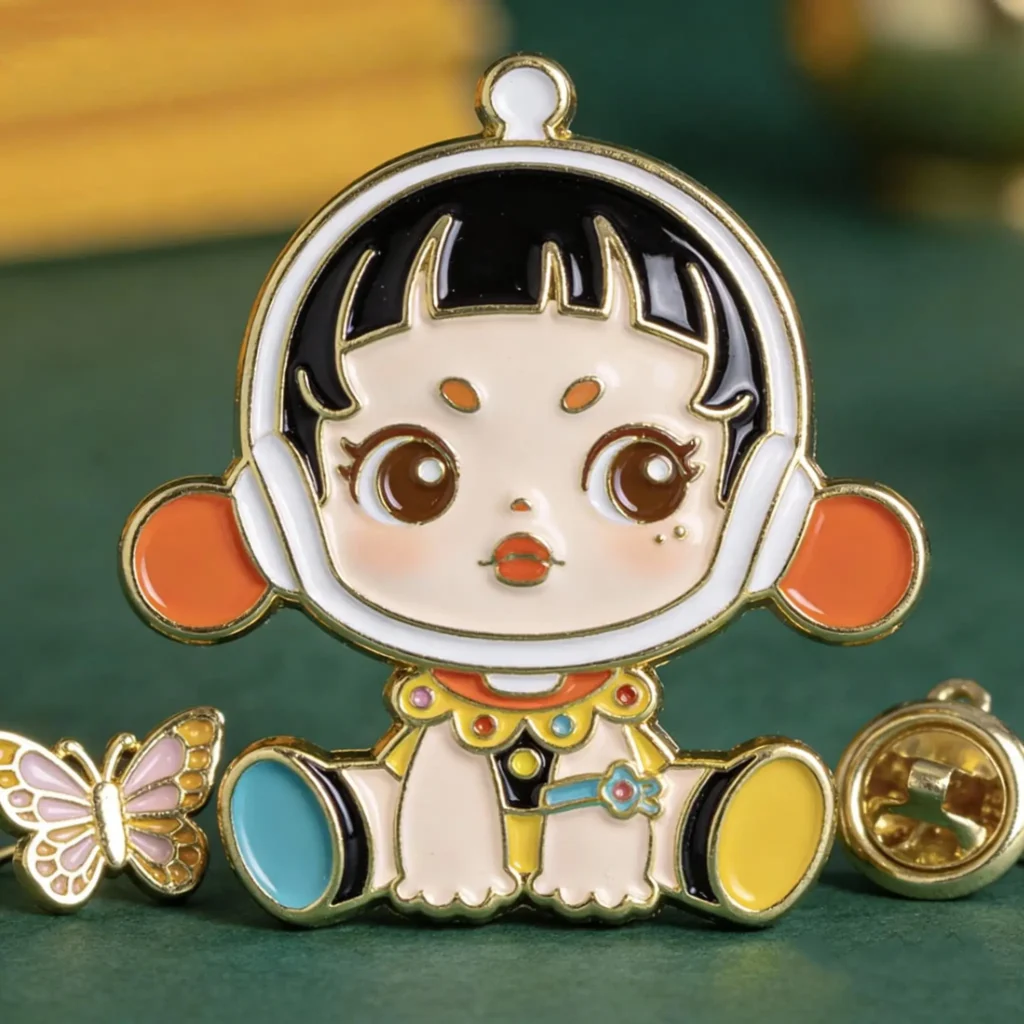
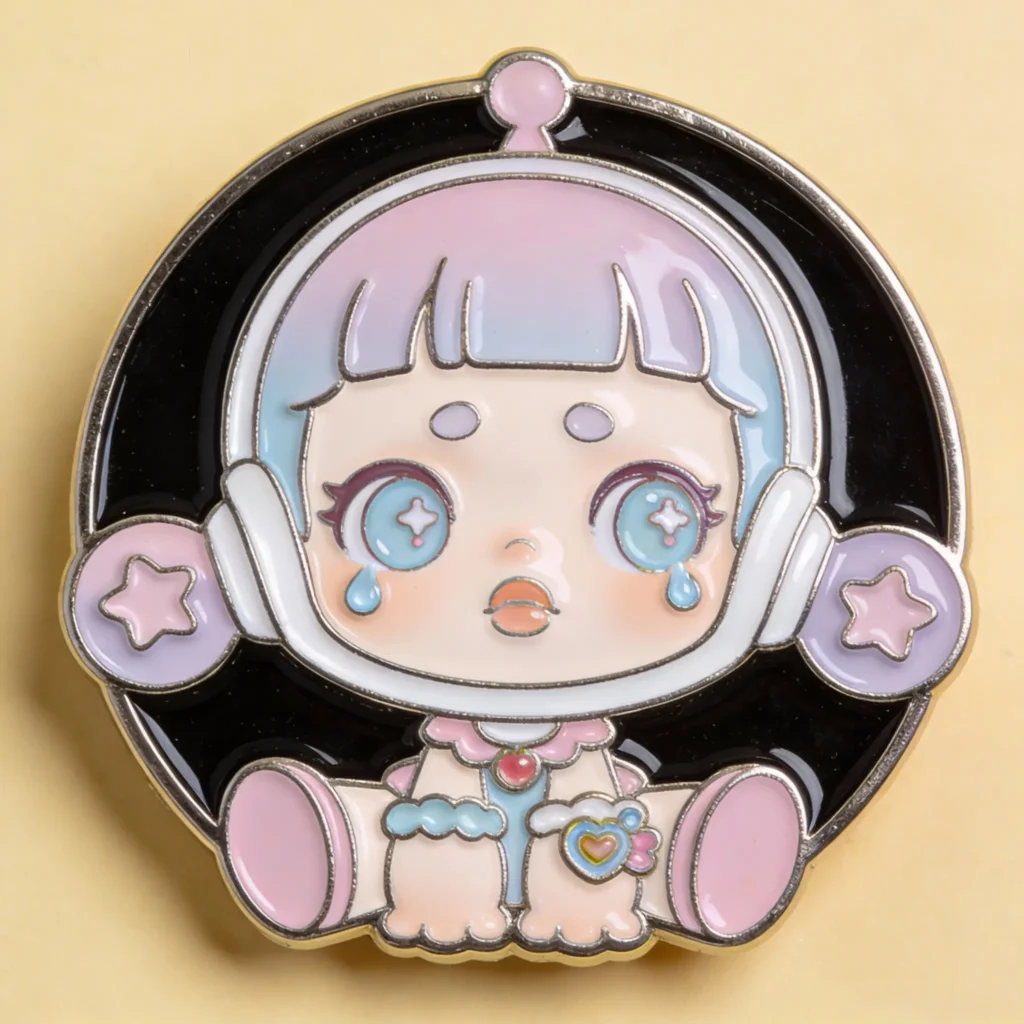
1. “Our Art Has Super Fine Lines and Details. Will They Just Disappear or Blob Together?”
The Short Answer: Not on our watch. Fine details are not only possible; they’re a specialty.
The How & Why:
The key is in the mold and the separation. Our master toolmakers work with your artwork to strategically translate lines into raised metal cloisons (the metal walls that hold the enamel). We determine the minimum practical width for these walls to ensure structural integrity while preserving design intent.
Pro Tip: Extremely fine, isolated hair strands might be subtly thickened or cleverly connected to another line for stability. We’ll always present a simplified mold proof for your approval, showing exactly how your details will be translated, ensuring nothing is lost without your consent.
2. “We Use Dozens of Colors and Subtle Gradients. Are Pins Limited to Just 6 Flat Colors?”
The Short Answer: While traditional soft enamel uses distinct color fields, the palette is far from limited, and we have brilliant solutions for gradients.
The How & Why:
- Color Count: We routinely work with 8-12 colors in a single pin. While there are practical limits (each color is a separate enamel fill), creative color blocking and strategic design can create the illusion of even more.
- Gradients & Blends: True seamless gradients are the holy grail. We achieve stunning gradient effects through:
- Half-Tone Printing: A screen-printing technique that applies enamel dots of varying density to create a smooth fade.
- Color Blending: For certain effects, we can manually blend wet enamels where colors meet, creating a soft transition.
- Strategic Separation: Breaking a gradient into 3-4 strategic color bands that the eye blends together naturally.
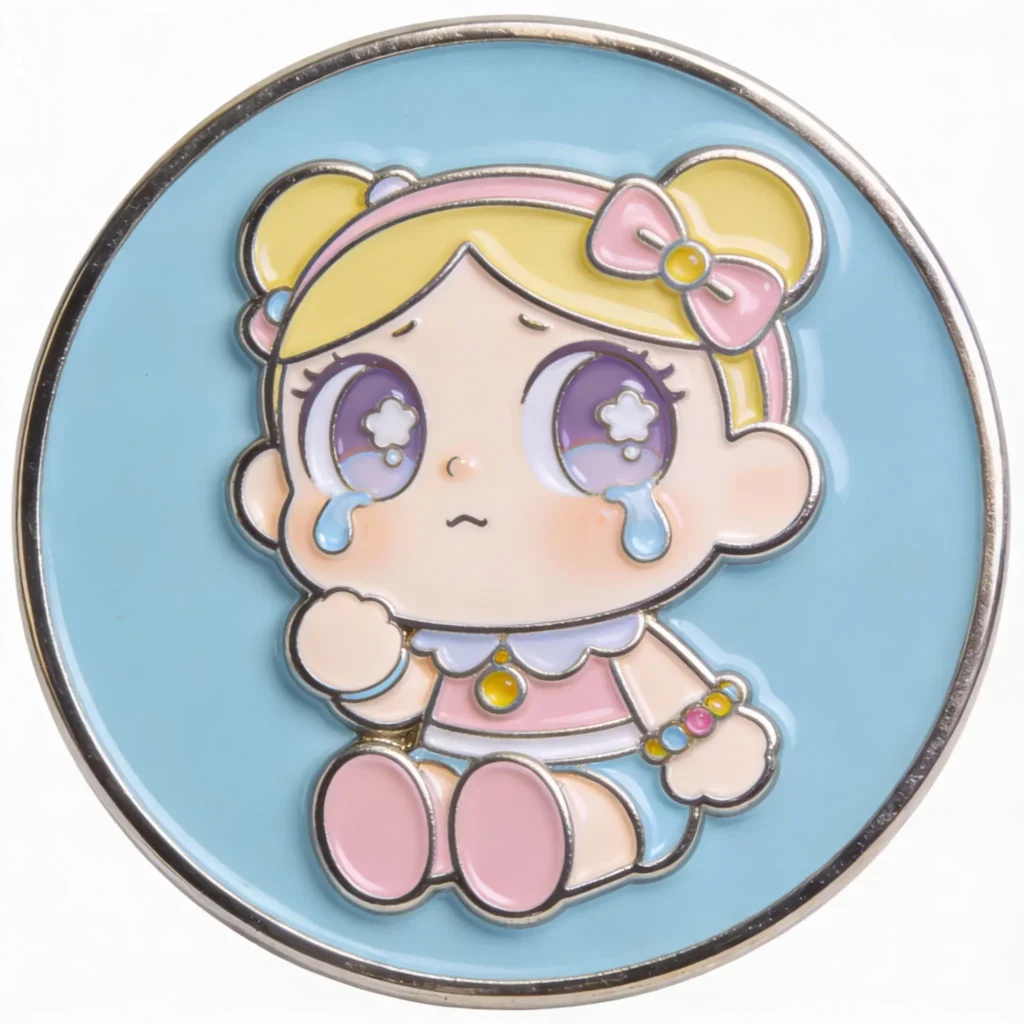
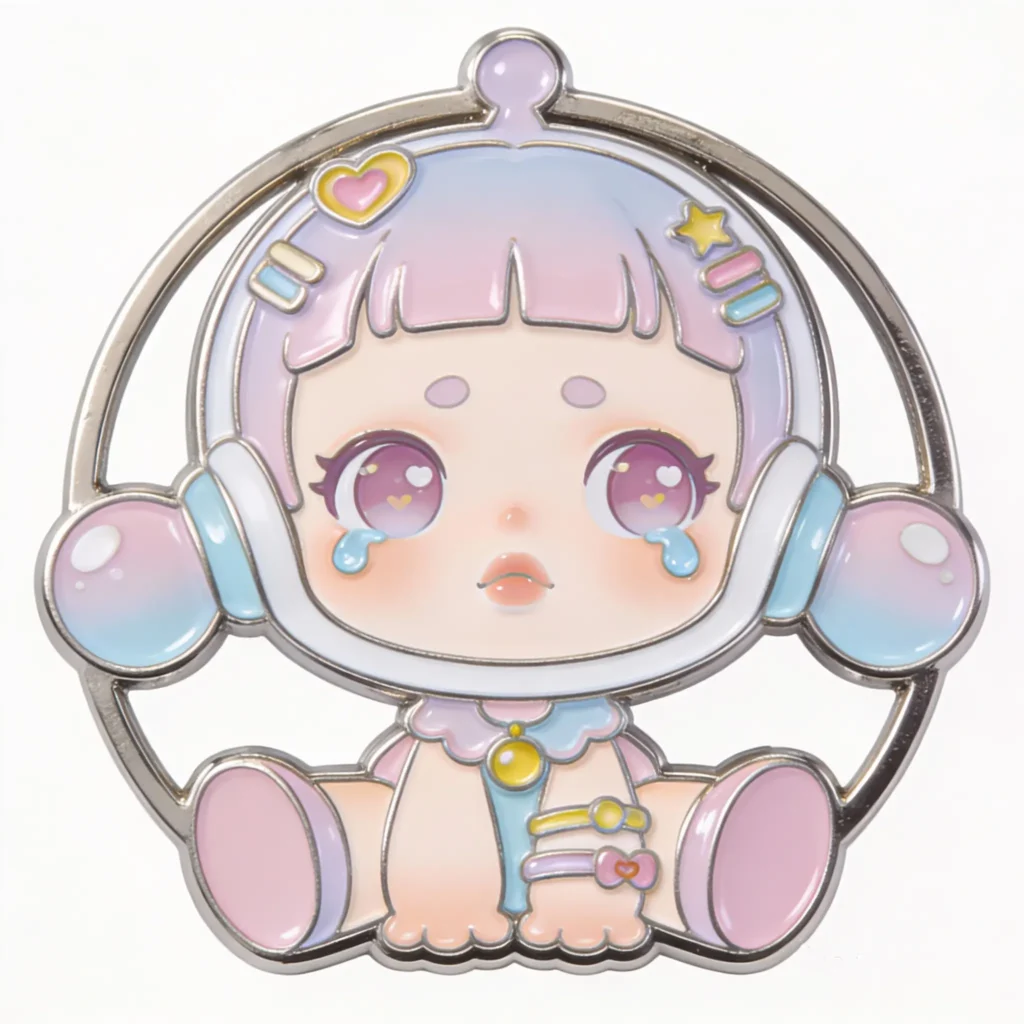
3. “Our Character Has Tiny but Crucial Features—Like a Specific Eye Sparkle or a Tiny Symbol. Can You Keep That?”
The Short Answer: Yes, but it may evolve from a painted detail to a textural or dimensional one.
The How & Why:
Micro-details painted in the original art often need a different treatment to survive molding and enameling. Our collaborative approach might suggest:
- Turning a tiny eye sparkle into a pierced hole (revealing the material beneath) or a raised metal dot.
- Making a tiny symbol a cut-out in the metal or a raised, un-enameled (silver or gold) detail.
- Using pad printing (a type of surface printing) to add ultra-fine painted details on top of the hardened enamel. This is perfect for intricate logos, pupil details, or tiny text.
4. “The Design Feels ‘Busy’ or Has a Complex Background. Will It Look Cluttered as a Small Pin?”
The Short Answer: This is where our design-for-manufacture expertise shines. We help you simplify strategically to enhance clarity and impact.
The How & Why:
A 1.5-inch pin is not a poster. What reads as “lively” on screen can become “chaotic” in metal. We act as your editor, suggesting ways to:
- Focus on the Hero Element: Isolate the core character or symbol.
- Simplify Backgrounds: Suggest turning a detailed forest into a suggestive, stylized silhouette.
- Use Negative Space: The metal base itself (often shiny gold or silver) becomes a crucial “color” that can frame and separate elements beautifully. Sometimes, removing elements adds more power.
5. “We Want Something That Doesn’t Look Like a ‘Normal’ Pin—Like a Weird Shape, Layering, or Mixed Media. Is That Possible?”
The Short Answer: Absolutely. This is where it gets fun.
The How & Why:
Modern pin manufacturing is an art form. Beyond the classic flat pin, we specialize in:
- 3D Modeling & Pewter Casting: For fully sculptural, dimensional pins.
- Layering (Step Designs): Creating depth by stacking two or more metal layers.
- Mixed Materials: Incorporating acrylic pieces, glitter inserts, epoxy domes, or even soft PVC elements into a single design.
- Unconventional Shapes: Long, dangling elements, interlocking parts, or pins that are all outline—we engineer the hidden pin posts and backing for stability.
Your IP, Expertly Translated
The journey from your screen to a fan’s lapel is a collaborative adventure. At 366pins, we see ourselves as your technical translators and creative problem-solvers. Our goal is never to say “no,” but to say “here’s how we can make that vision work.”
The most complex designs often become our most celebrated pins. The constraints of the medium don’t stifle creativity—they challenge it, leading to innovative and often more iconic final products.
Don’t let design complexity hold your merch line back.
Send Us Your “Impossible” Design.
Challenge us with your most intricate character or logo. and let our experts show you the path from stunning art to an even more stunning enamel pin.